
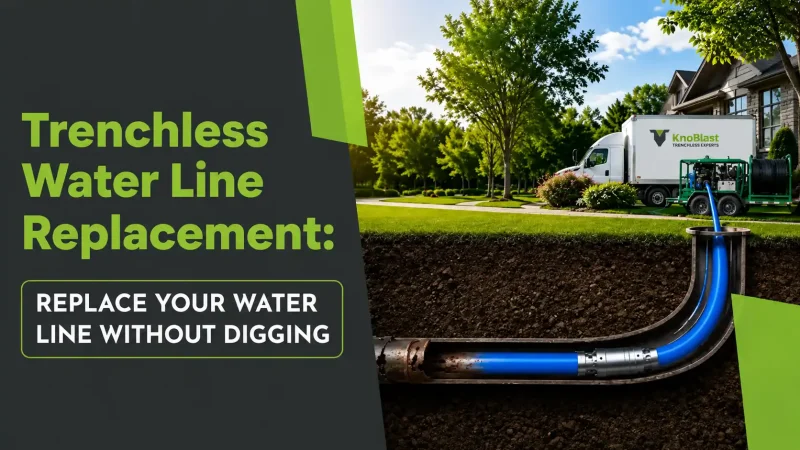
If you have ever seen a bunch of crew members tearing up a sidewalk to replace a water line, you know why “trenchless” has become one of the most searched terms in residential plumbing. Earlier, traditional water line replacement meant waiting several days before functionality was restored and paying a heavy amount for all the repairs. Trenchless water line replacement changes that equation.
Calgary homeowners have become more aware of underground water infrastructure following the 2024 Bearspaw South Feeder Main rupture, which disrupted water service for hundreds of thousands of residents. That incident involved a municipal feeder main rather than a residential service line; it still highlighted how vulnerable buried water infrastructure can be and why maintaining aging water lines before they fail is so important.
This guide walks through how trenchless water line replacement actually works, when it makes sense, what it costs in 2026, and how to decide whether it’s the right choice for your home.
What Is a Water Line and Why Does It Need Replacement?
Your water line is an underground pipe that carries fresh water from the municipal main under the street into your home. It is buried approximately 3 to 6 feet deep, depending on your region’s frost line. The homeowners are responsible for maintaining the portion of the line from the curb stop to the house. The main line section connecting to the street is owned and maintained by the utility. The exact boundary varies by city, so it’s worth checking with your local water department if you’re unsure.
The real issue here is that water lines do not last forever. Older homes in neighborhoods like Hillhurst, Inglewood, and Upper Mount Royal often have galvanized steel or copper lines, which degrade over time. Galvanized steel is prone to internal rust and mineral buildup. This shows up as discolored water, reduced water pressure, or a metallic taste. Copper, on the other hand, is more durable and can last up to 50 years, but it’s expensive to replace.
Common warning signs that your water line needs replacing include:
- A continuous low pressure throughout the house.
- Discolored or rusty water
- Unusual wet spots or surprisingly green areas in your yard.
- A spike in your water bill with no obvious cause.
- Frequent repairs or leaks on the same section of the pipe.
If you have been experiencing any of the issues mentioned above, it’s recommended to call an expert for water line inspections in Calgary before opting for a repair method.
Schedule a professional inspection to identify the root cause and determine whether a repair or full replacement is the best solution. Our experienced team provides reliable water line inspections in Calgary to help homeowners protect and restore their water service with confidence. Contact us today to book your inspection.
What Is Trenchless Water Line Replacement?
Trenchless water line replacement is a process where damaged underground pipes are replaced or repaired without digging a continuous trench along their entire length. Instead, the crew digs two small access points, one near the curb and the other near the point where the pipe enters the house. All the underground work is done between these two points.
There are two main trenchless methods used for water service lines, and understanding the difference matters because they solve different problems.
1 Pipe Bursting
Pipe bursting is a trenchless method used to replace damaged pipes by breaking them apart from the inside while pulling a new pipe into the same path. Water excavating contractors thread a hydraulic bursting head through the existing pipe from one access pit to another. As it is pulled through, it fractures the old pipe outward into the surrounding soil, and a new pipe is towed directly behind it.
Pipe bursting is the fastest and least expensive trenchless option and can be completed in one day. The condition is that the existing pipe has to be intact enough to guide the bursting head through it.
If the old pipe is seriously damaged in sections or completely collapsed, pipe bursting isn’t a reliable option.
2. Horizontal Directional Drilling (Directional Boring)
Horizontal Directional Drilling takes a different approach to pipe repair. Instead of following the old pipe’s route, the HDD method creates a completely new underground path. The process starts by drilling a pilot bore between the two access points. This is guided by real-time steering, so the operator can navigate around obstacles such as tree roots, foundations, or other utility lines. After the pilot hole is established, the bore is gradually widened, and the new HDPE pipe is pulled through on the final pass.
HDD method is a suitable option if the old pipe has completely collapsed or needs to be rerouted. This method offers the greatest flexibility of any trenchless method, but requires more specialized equipment and can cost more than pipe bursting.
A third method worth knowing, which is more common on sewer line repairs than on water lines, is cured in place pipe lining. This involves inserting a resin-coated liner into the existing pipe and curing it in place to form a new pipe within the old one.
For a Detailed Insight, Also Read: Sewer Line Trouble? Here’s How to Fix It Without Digging Up Your Yard
Trenchless Water Line Replacement vs. Traditional Trenching
If you are looking for a sewer line or water line repair, one of the first questions you’ll face is whether to go with a trenchless or traditional trenching method. Both methods solve the same problem, but the process, overall cost, and impact on your property are very different.

Here’s a closer look at how each method works and when it makes the most sense.
How Traditional Water Line Replacement Works
Traditional trenching is a method that has been used for years to replace damaged pipes. The process involves excavating a continuous trench from one end of the damaged pipe to the other. This gives the contractors direct access to the entire length of the pipeline so they can remove the old pipe and install a new one.
While this method has been used extensively for decades, it can significantly disrupt your property. To reach the pipe, contractors may need to dig up lawns, sidewalks, fences, or driveways, resulting in major restoration costs and additional time.
Traditional trenching is generally recommended when:
- The existing pipe has completely ruptured
- Multiple underground utilities need to be replaced side by side
- The pipe is located too close to the other infrastructure
- Extensive excavation is already planned as part of a larger construction or renovation project.
How Trenchless Water Line Replacement Works
Trenchless is a modern method used for replacing damaged underground water lines without needing extensive digging along the length of the pipe. Utility contractors need to dig only two access points to remove and replace the damaged pipe. Two methods are commonly used for trenchless repairs: CIPP and pipe bursting, which we have discussed in detail above.
Key Differences Between Trenchless and Traditional Trenching:
| Feature | Trenchless Pipe Replacement | Traditional Trenching |
|---|---|---|
| How It Works | Replaces or rehabilitates the pipe through one or two small access pits using methods such as pipe bursting or cured-in-place pipe (CIPP) lining. | Requires a continuous trench to be excavated along the entire length of the damaged pipe before installing a new one. |
| Excavation Required | Minimal excavation. | Extensive excavation across the entire pipe route. |
| Impact on Landscaping | Preserves most lawns, gardens, trees, driveways, patios, and sidewalks. | Significant disruption to landscaping, hardscaping, and outdoor features. |
| Installation Time | Typically 1–2 days, depending on the project. | Usually 3–7+ days, depending on excavation, weather, and restoration requirements. |
| Property Damage | Little to no damage to existing property minimizes repairs after installation. | High potential for damage to lawns, flower beds, fences, retaining walls, and paved surfaces. |
| Cost of Restoration | Lower restoration costs since minimal digging means fewer repairs to landscaping and hardscaping. | Higher restoration costs due to replacing sod, plants, concrete, asphalt, pavers, and other disturbed areas. |
| Overall Project Cost | May have a higher upfront installation cost but often results in lower total project costs because restoration expenses are significantly reduced. | Initial excavation may appear less expensive, but restoration, labor, equipment, and cleanup often increase the overall cost. |
| Labor Requirements | Requires fewer workers and specialized trenchless equipment. | Requires larger crews, heavy excavation machinery, and additional restoration teams. |
| Equipment Used | Uses specialized trenchless equipment such as hydraulic pipe bursting, CIPP, Inversion drums, and CCTV camera inspections. | Uses excavators, backhoes, trenchers, dump trucks, compactors, and heavy earthmoving equipment. |
| Best Use Cases | Ideal for repairing cracked pipes, root intrusion, corrosion, minor collapses, leaking joints, and aging sewer lines while preserving the property. | Best for severely collapsed pipes, significant ground movement, major structural failures, or situations where trenchless methods are not technically feasible. |
| Safety | Reduces risks associated with deep trench excavation, cave-ins, and prolonged construction zones. | Higher safety risks due to open trenches, heavy machinery, and excavation hazards that require strict safety measures. |
| Noise & Dust | Produces less noise, vibration, dust, and airborne debris because excavation is limited. | Generates considerably more noise, dust, vibration, and debris from excavation and heavy equipment. |
Note: Every sewer repair project is unique. The information above is intended as a general comparison, and a professional inspection is necessary to determine the best repair approach for your property.
Water Line Replacement Cost in Calgary (2026): Trenchless vs. Traditional
The cost of water line repair in Calgary in 2026 depends on several factors. This includes the pipe’s length and depth, along with the extent of the damage. It also depends on the method of repair being opted for, local labor cost, and accessibility.
Trenchless Water Line Repair
- Typical cost: $80–$250 per linear foot
- Initially, a higher upfront cost due to specialized equipment and advanced repair methods.
- Requires little to no excavation and helps reduce labor and restoration costs.
- Often provides better long-term value for properties with significant landscaping or hardscaping.
Traditional Trenching
- Typical cost: $50–$200 per linear foot (before restoration).
- Lower initial pipe replacement cost in many cases.
- Requires full excavation along the sewer line.
- Additional costs may include excavation, debris removal, backfilling, and restoring damaged property.
- Repairing driveways, sidewalks, patios, and landscaping can significantly increase the final project cost.
- Longer project timelines often result in higher labor expenses.
Which Option Offers Better Value?
While trenchless water line replacement may cost more initially, it is often a more cost-effective choice when you consider excavation, minimal property damage, and lower restoration costs. Traditional trenching may still be necessary for severely collapsed pipes or situations where trenchless methods are not feasible.
Disclaimer: These 2026 cost ranges are general estimates and are subject to change based on your location, pipe material, depth, accessibility, permit requirements, and contractor pricing. A professional camera inspection is the best way to determine the most accurate cost for your project.
How to Choose the Right Water Line Replacement Method
Choosing between trenchless and traditional repair comes down to several factors, like the complexity of the issue, property layout, and your budget. A professional inspection can help determine which approach will provide the safest, most cost-effective, and long-lasting results.
Here are the key factors to consider:
- Choose trenchless water line repair if the pipe has cracks, corrosion, or minor structural damage but is still suitable for restoration.
- Choose traditional trenching if the pipe has completely collapsed, is severely misaligned, or has serious structural damage that can not be repaired using trenchless technology.
- Consider your budget carefully. Traditional trenching may have a lower repair cost initially; however, restoration expenses for sidewalks and landscaping can increase the final bill.
- Consider your property’s future value. Preserving mature landscaping, outdoor living spaces, and hardscaping can help maintain your home’s curb appeal and reduce post-repair maintenance costs.
Expert Tip: The best way to find out the right repair method is to schedule a professional camera inspection. A sewer repair contractor can easily assess the condition of the pipes, the root cause of the problem, and recommend the most suitable option based on your property’s specific needs.
Why Choose TerraBurst for Trenchless Water Line Replacement?
At TerraBurst, we bring together years of experience, combining advanced trenchless technology to deliver fast, reliable, and non-invasive pipe replacement.
Here’s why homeowners trust TerraBurst for their water line replacement in Calgary:
- Experienced Trenchless Specialists: Our team is qualified to identify water line problems and recommend the most accurate solution based on your property’s condition.
- Minimal Property Disruption: We believe in fast turnaround times and causing minimal disruption to your property, which is why we use a trenchless method that eliminates the need for costly restoration work.
- Honest Recommendations: Our customers have always appreciated our honest recommendations for different issues. We inspect the layout of your property and identify the issue causing disruptions. Based on these findings, we recommend the most suitable replacement option.
- High-Quality Materials and Workmanship: We use durable and industry-approved materials designed to provide reliable performance for years to come.
- Trusted by Homeowners: Homeowners in Calgary have trusted us for years for quality workmanship and customer satisfaction, which is reflected in our reviews. We not only provide dependable service but also build long-term relationships with our customers through exceptional outcomes.
Read more reviews about TerraBurst on Google Reviews.
Final Words
Sewer or water line problems do not solve themselves and can quickly disturb your daily routine if left unchecked. When traditional excavation is required, repairs may involve digging through your yard, sidewalks, or other structures. This often leads to longer turnaround times and higher restoration costs. Trenchless water line replacement offers a less invasive option, causing minimal disruption, but it isn’t the right solution for every type of pipe damage.
The best way to identify the right repair method is to book a professional camera inspection. A utility contractor can assess the condition of your water line and find out the main cause of the problem. Based on these findings, they can recommend whether trenchless repair or traditional trenching is the most effective solution for your home.
Need Expert Advice on Your Water Line? If you’re unsure whether trenchless sewer repair or traditional trenching is the right solution for your home, a professional camera inspection can provide the answers. At TerraBurst, our experienced water line repair contractors in Calgary assess your line’s condition and recommend the most effective repair method for your property’s needs.
Contact us today to schedule an inspection and receive honest, expert guidance.
Frequently Asked Questions
- Is trenchless water line replacement worth it?
- Trenchless water pipe replacement is absolutely worth it, especially if your water line runs beneath a driveway, sidewalk, or landscape. This method causes minimal disruption to your property and does not require extensive digging like the traditional method. The initial cost is somewhat higher than the traditional method, but reduced restoration work and faster turnaround times can make it a more cost-effective solution.
- How long does trenchless water line replacement last?
- When installed using high-quality materials such as HDPE piping, trenchless water line replacement can last 50 to 100 years. The lifespan depends on factors such as soil conditions, water quality, installation quality, and regular maintenance.
- Can every water line be replaced using trenchless methods?
- Not really, the trenchless method is not suitable for every water line. If the existing pipe has completely collapsed or is severely misaligned, traditional excavation may be the better option. It’s always recommended to get a camera inspection done by professionals to identify the issue and then opt for a solution that suits the requirements.
- How do I know if my water line needs to be replaced instead of repaired?
- There are several signs that suggest a water line replacement is needed. If you have noticed frequent leaks, low water pressure, discolored water, and unusually high water bills, it may indicate a problem with your water pipe. A water pipe camera inspection is needed to find out the exact issue and whether a repair or replacement is needed.
- Will I lose water service during the replacement?
- Yes, your home’s water supply will typically be shut off while the old water line is disconnected and the new one is installed. However, because trenchless replacement is generally completed quickly, water service is often restored the same day or within 24 hours.
About the Author
Collin Reardon is the Founder and CEO of TerraBurst and brings over 40 years of combined industry experience in trenchless sewer and water line repair solutions across Calgary and surrounding areas. Under his leadership, TerraBurst has helped homeowners and businesses solve sewer problems with reliable, affordable, and long-lasting repair solutions.